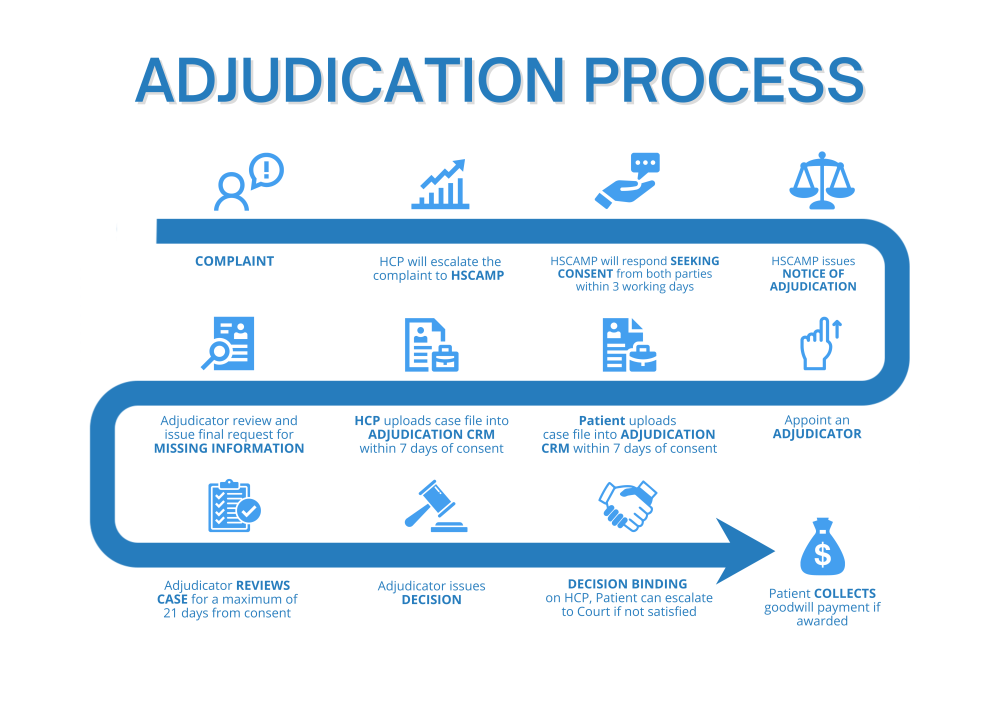
Adjudication
Fair Review
Adjudicators conduct thorough and impartial reviews of all aspects of the complaint with a strong commitment to fairness and compassion.
Binding on the Provider
Where the patient accepts the decision, it is binding on the Health Care Provider. It does not bind the patient, whose statutory rights, including the right to go to court, are unaffected. Either party may ask for a review within 14 days on the grounds set out in the Scheme Rules. Goodwill awards are capped at £5,000.
Qualified Adjudicators
Adjudicators are selected based on their background and experience to ensure a strong match to the issues underpinning the complaint.
Streamlined Process
Effective utilisation of technology and organisational resources enables Adjudicators to render decisions within 28 working days of receiving the complete case file, and within 90 days at most.

Why Adjudication is Crucial for Healthcare Providers
While the adjudication process ensures fairness for patients by providing them with a platform to voice their concerns and seek timely resolutions, access to independent adjudication has become crucial for healthcare providers, including individual dentists and doctors, due to the increasing significance of no win no fee solicitors in the medical space.
Before taking a case, a no win no fee solicitor evaluates it based on three key areas: merit, financial risk, and time and resources versus expected payout. However, the merit assessment is often primarily based on the patient’s biased information, limiting the healthcare professional’s opportunity to present their side at this early stage. When the patient instructs the solicitor and the solicitor establishes contact with the healthcare provider, the provider must inform their professional indemnity insurers of the potential claim. At this point, the healthcare professional loses control of the process, as the insurance company and their solicitors take over. In the absence of any determination of liability or wrongdoing, the healthcare provider may face significant costs, including increased insurance premiums during the next renewal, the responsibility to pay the excess on their policy (which could be as high as £10,000 per claim), and potential liability for any settlement, aggressively pursued by a determined solicitor.
How can Adjudication Help Reduce this Risk?
Merit assessment: If an independent adjudication decision has already determined that the healthcare professional is not at fault or liable for the case, it can serve as strong evidence against the viability of the claim. No win no fee solicitors will be less inclined to take on such cases without the patient being a direct pay client.
Financial risk: No win no fee solicitors bear the financial risk of the case. Taking on a case that has already received an unfavourable adjudication decision may diminish their confidence in winning or securing a favourable outcome, impacting their decision to proceed.
Time and resources: Given the significant time and resources required for legal cases, solicitors may question the wisdom of pursuing a case that has already received an adjudication decision, prioritising other cases with stronger prospects of success.
Deterrence for frivolous claims: Expert adjudicators can act as a deterrent for individuals tempted to make baseless or frivolous claims. No win no fee solicitors are more likely to identify and dismiss such complaints before they are instructed, knowing that an expert adjudicator has evaluated their validity and issued a robust report.
Objective decision-making:
Involving an impartial adjudicator ensures an unbiased evaluation of the complaint. The adjudicator reviews evidence, assesses relevant information, and makes an objective decision, giving both the patient and the provider a clear, evidence based answer.
By offering independent adjudication as stage 3 of their complaints process, and asking patients in their complaints information and consent documentation to use this stage before starting court proceedings, providers give patients a free and faster route to an independent decision. Patients can take legal advice at any time and keep their statutory rights, including the right to go to court.
Adjudication gives patients an independent route to have their complaint reviewed, and gives providers an early, expert and documented resolution before matters escalate. Adjudication is voluntary for the patient. A patient’s right to take legal advice, or to bring a claim, at any stage is not restricted, and the outcome of an adjudication may differ from an outcome determined by a court applying legal rules.
How Do Claims Impact Insurance Premiums?
Consider Dr Smith, who pays £35,000 annually for his medical indemnity policy. Over the past year, he has had 4 complaints made against him, obliging his insurer to reserve £270,000 for potential settlements. The insurer’s solicitors believe all claims are highly defensible, supported by expert opinions affirming the correctness of Dr Smith’s surgical procedures and post-operative care. Despite this, the insurer has quoted Dr Smith £75,000 based on the Expected Loss Ratio methodology for the upcoming year’s premium. Such a steep increase in premiums will financially pressure Dr Smith, possibly pushing him towards early retirement so he can access his run-off coverage for past surgeries.
Compounding Effect of No Win No Fee Solicitors
‘No win, no fee’ solicitors have made it easy for patients to bring a claim by eliminating upfront legal fees and enabling those who might not be able to afford traditional legal services to pursue their claim. These types of arrangements, coupled with external pressures like the cost-of-living crisis, have resulted in a significant increase in claims. Solicitors working on a ‘no win no fee’ basis understand that insurance companies are more likely to settle claims, even those without strong merit, due to the certainty and cost-effectiveness of settling compared to contesting the claim in court.
Consequently, with a higher volume of claims, insurers face the likelihood of more payouts, necessitating the need to allocate higher reserves and charging higher premiums at renewal.
The Power of Adjudication
By subscribing to adjudication and setting out the complaint process clearly in his complaints information and consent documentation, Dr Smith can offer patients an independent review as a faster alternative to legal action. Patients keep the right to take legal advice at any time. Where an expert adjudicator finds that a complaint has no merit, a no win no fee solicitor bearing the financial risk is less likely to take it on, and a patient with a weak claim is less likely to pursue it at their own cost.